
other
25. März 2026
Cooling Tower Basics: Types, Working Principle, Losses, and Design Parameters
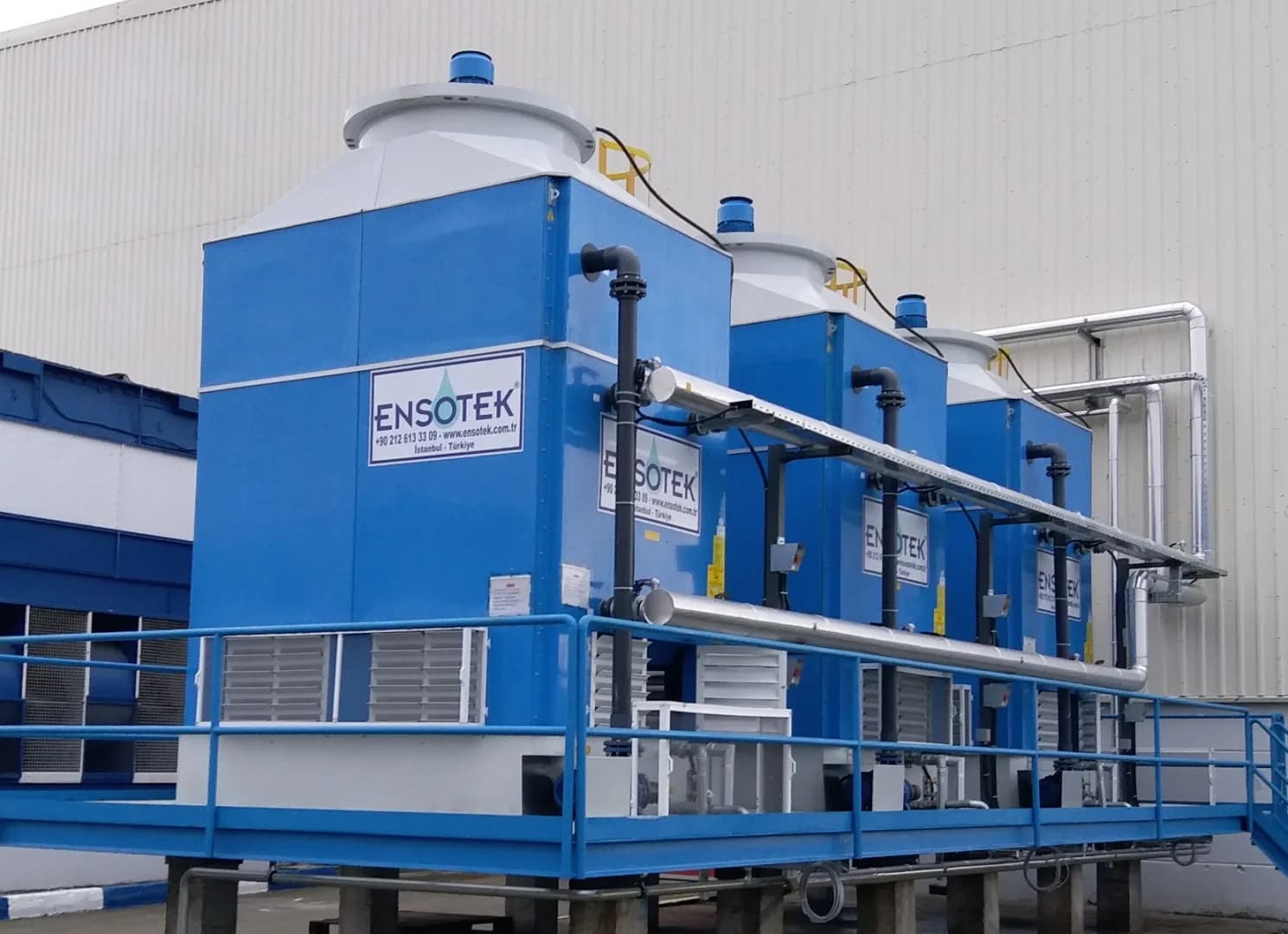
What Is a Cooling Tower?
A cooling tower is a heat rejection device that removes heat from warm process or HVAC water and releases it to the atmosphere. A small portion of water evaporates and carries away heat. The cooled water is collected in a basin and returned to the system.
How It Works
- Distribution: warm water is distributed over fill media.
- Surface area: film/droplet formation increases heat transfer area.
- Airflow: fan (or natural draft) moves air through wetted surfaces.
- Heat transfer: sensible + partial evaporation cools the water.
- Collection: cooled water returns to the loop.
Counterflow vs Crossflow
Counterflow: air moves upward while water moves downward. Crossflow: air moves horizontally/diagonally relative to falling water.
Open vs Closed Circuit
Open circuit towers directly expose process water to air. Closed circuit towers keep process fluid inside a coil while spray water + air reject heat.
Key Design Metrics
- Range: hot-water inlet minus cold-water outlet.
- Approach: cold-water outlet minus wet-bulb temperature.
- Wet-bulb: practical performance limit for evaporative cooling.
Water Losses
- Evaporation: inherent heat removal mechanism.
- Drift: droplets carried out with exhaust air; reduced by drift eliminators.
- Blowdown: controlled purge to manage dissolved solids (TDS).
Operation and Maintenance
- Water treatment (scale/corrosion/biological control) is essential.
- Periodic inspections: nozzles, fill, drift eliminators, fan/motor group, basin hygiene.
Bildergalerie
Ensotek tower body and fill example
Fill section and airflow
Field installation example