
other
23. März 2026
Open-Circuit Cooling Tower Working Principle
Air flowWater loopFill mediaFan
Open-Circuit Cooling Tower Working Principle
What Is an Open-Circuit Cooling Tower?
In an open-circuit (open-loop) cooling tower, the process water comes into direct contact with air. Most heat rejection is achieved through evaporation, which typically provides high thermal performance. Because the water is exposed to the environment, water quality management (scaling, fouling, biological control) is essential.
Core Heat-Rejection Mechanisms
- Sensible heat transfer: heat moves from water to air due to temperature difference.
- Latent heat (evaporation): a small portion of water evaporates and removes additional heat via phase change.
Counterflow vs. Crossflow Arrangements
Counterflow: air rises while water falls. Crossflow: air moves horizontally/diagonally across the falling water.
Induced-Draft Counterflow: Step-by-Step
- Hot water enters the distribution header.
- Nozzles distribute water evenly over the fill.
- Fill increases surface area by creating films and droplets.
- Fan induces airflow through louvers and across the fill zone.
- Heat is rejected: water cools; a fraction evaporates.
- Cooled water collects in the cold-water basin.
- Moist air discharges through the fan stack; cooled water recirculates back to the process.
Key Components
- Structure & basin
- Water distribution & nozzles
- Fill media (film or splash)
- Fan & motor
- Drift eliminators to reduce droplet carryover
- Louvers for airflow control
Performance Terms
- Range: Tin − Tout.
- Approach: Tout − Twb.
- Wet-bulb: dominant climate parameter for tower capacity.
Water Losses
- Evaporation
- Drift
- Blowdown
Summary
Open-circuit towers cool by direct contact and partial evaporation. With proper design and operation, high performance is achievable while controlling water losses via drift elimination and blowdown strategy.
Bildergalerie
Open-circuit cooling tower working principle
Fill section and airflow
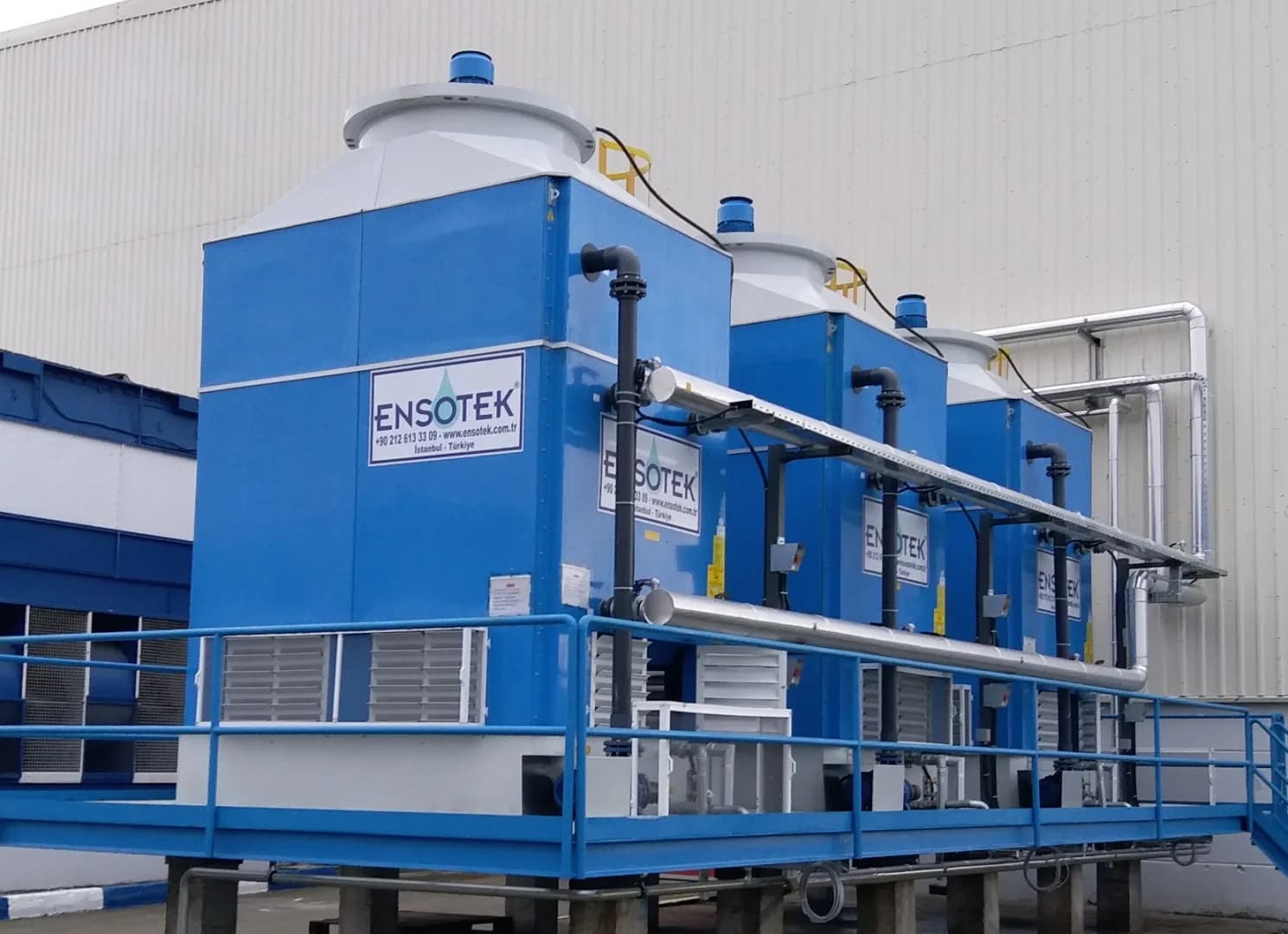
Field installation example